Land for sale in Galicia, Spain

Buildable property for sale on a coastline of incomparable beauty.

Showing posts with label past. Show all posts

Sunday, 5 June 2011

A successful business (ad)venture

This blog is not just a business venture--it's not just about offering an unrivaled real estate investment. It's turned into a chance for me to reminisce and to share some memories, anecdotes and stories with my readers--anecdotes and memories related to the land that's been in my family for generations, to the place where my dad was born, to an incredible little fishing village called Caión. I so enjoy writing about the truths and tales I've been hearing all my life, like the (true) one I'm going to write about today.

Restaurant "Casa de la Fuente"
I'd like to tell you a little about the business that my enterprising mom and dad ran between 1955 and 1969 in Caión. When they married, my parents decided to settle down in Caión (my mom was from Lendo, a nearby village) and set up a small grocery store on the ground floor of a house located in the main square of this tiny peninsula. They began selling oil, sugar, flour and other basic food stuff during what were very hard times for Spain's population. My mom still remembers how they sometimes sold just a little bit of oil to a customer who simply could not afford more--maybe no more than 1/8 liter at a time.

Inside the café-restaurant
It turns out that my mom was a tremendously hard working woman and an excellent cook. My dad was also a hard-worker, but when it came to cooking, he knew better than to try a hand at the culinary art. They soon set up a new business in that same locale. They turned that small shop into a café, restaurant and hostel which eventually became as popular with tourists from Madrid and other areas of Spain or Galicia, as with the locals.

My parents' fish delivery truck
In one of my last posts I mentioned the popularity of my mom's Spanish tortilla and promised to upload her recipe, so here it is. But tortilla, although the most controversial, wasn't the only popular dish on the menu. She made other specialties such as seafood, tripe stew with chickpeas (callos), octopus, among others. Wedding parties were also celebrated at the restaurant. Their business became very successful and so well known that even an association of French chefs once wrote to ask if they could hold their annual convention at my parent's restaurant.

My parents' fishing boat

And regarding the hostel, they could boast of guests such as a cousin of the present-day king of Spain, H.M. King Juan Carlos I. Less illustrious but still fondly remembered guests include two very young geologists from Holland who spent four summers in Caión while they were working on their PhD. Caión was such an isolated place back then that I used to wonder how these people could possibly have got to know about it and about Casa de la Fuente. Perhaps the article I'm attaching here (there were others) can shed some light on the matter. Another mystery is how these people were actually able to reach Caión at that time. Roads were not like they are today and the way to Caión was one of the scariest in the area. No doubt the landscape and natural beauty of this unique spot, as well as the impressive cuisine were to blame.

The road to Caión is no longer frightening and the village is well-communicated, but luckily it hasn't lost its charm. Beauty in nature never fades. So why does ours?

Sunday, 15 May 2011

A bit of history

Sunday, 30 January 2011

Past, present and future: towards a sustainable urban development


I can't believe how much Caión has changed! Some of those changes are positive, others not so much. At times I wish this fishing village were still the isolated, solitary, wild and unique paradise it once was! But then I realize that this romantic idea isn't consistent with urban growth and development, which are not only inevitable, but necessary.
Women mending fishing nets.
Small boat (chalana) arriving at Caión harbor.

Still, as long as that growth and development is responsible, sustainable and respectful of the environment, I'm willing to let go of my romantic ideas—or maybe not entirely. I guess I'm just an urban romantic who's convinced that a sustainable urban development is vital to the health of our own and of other communities.

No one can deny that coastal apartments are, even today, a capital investment. What they should not be is an example of what we call "feísmo urbano" (urban ugliness). Even if we can't prevent others from contributing to the destruction of our historical heritage or our urban and natural resources, I am convinced that we can support and improve our environment through sustainable projects such as the one we could develop on this exceptional plot of buildable land. There's nothing to stop us from enjoying a home here in the midst of an alluring sea and landscape while at the same time making an excellent investment that can help Caión to continue growing and developing in the best and most responsible way possible.


There is very little buildable property left in this fishing village and with the sea as a backdrop! I would personally love to build a small apartment complex or even a private house here, but it's not within my reach at the moment and besides, I'm involved in other projects of a different sort. This is why I am looking for an enthusiastic, enterprising investor willing to purchase the land, accept the challenge and "build" their hopes up high in this wonderful place.

Monuments


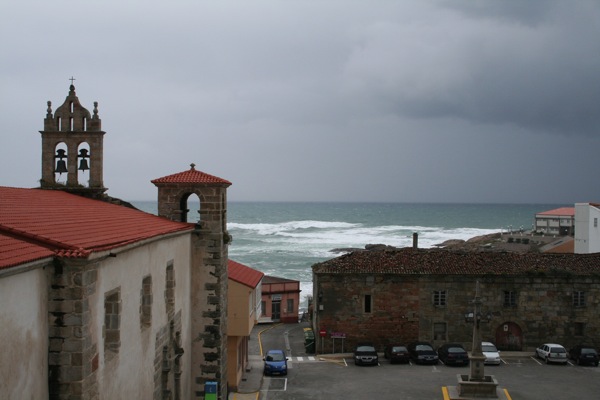
This small fishing village can also boast of its monuments, such as the 16th c. Augustine convent located in the main square, of which only the church remains intact. In the same square is the Manor house of Bermúdez de Castro, also from the 16th c. and finally, the shrine of Our Lady of Miracles, which pilgrims visit every year between the 6th and 9th of September.

Sunday, 23 January 2011

Whale bones and other stories


My father could still remember when, on a stormy day, the sea would cross the main square of Caión. He also recalled when whale bones were placed there to be used as benches—whalebone seats for a lazy afternoon. You might not know it, but Caión was once a whaling village.

Thursday, 20 January 2011

Avant-garde engineering

An article about the avant-garde architectural & engineering project that's going to transform Caión's port was recently published in the regional newspaper "La Voz de Galicia". Read the article (Spanish)